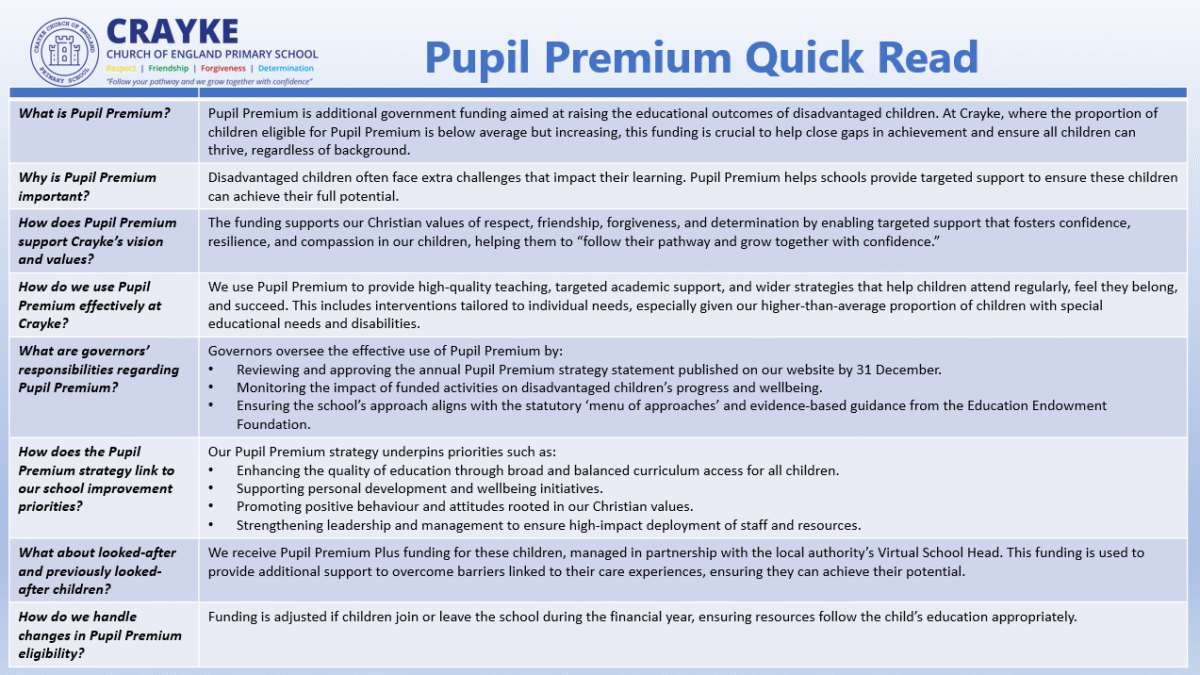
The Government believes that the Pupil Premium, which is additional to main school funding, is the best way to address the current underlying inequalities between children eligible for free school meals (FSM) and some of their peers by ensuring that funding to tackle disadvantage reaches the pupils who need it most.
The Pupil Premium is allocated to schools for children of statutory school age from low income families who are known to be eligible for free school meals, to children who have been looked after continuously for more than six months and to children whose parents are currently serving in the armed forces. At present this also includes pupils who have been eligible for FSM at any point in the last six years (known as the Ever 6 FSM measure).
Schools are free to spend the Pupil Premium as they see fit. However they will be held accountable for how we have used the additional funding to support pupils from low-income families. From September 2012 schools are required to publish online information about how they have used the Premium to ensure that parents and others are made fully aware of the attainment of pupils covered by the Premium and the extra support that they receive.
The range of provision staff and governors may consider include:
Accessing Pupil Premium Funding
Funding is allocated to the school based on an annual basis. It is important that if you think your child is eligible for pupil premium support, you should contact the school office for more information.
Important: To find out more information on whether you are eligible for additional funding, please click here.
| Cookie | Duration | Description |
|---|---|---|
| _GRECAPTCHA | 6 months | Google Recaptcha service sets this cookie to identify bots to protect the website against malicious spam attacks. |
| cookielawinfo-checkbox-advertisement | 1 year | Set by the GDPR Cookie Consent plugin, this cookie records the user consent for the cookies in the "Advertisement" category. |
| cookielawinfo-checkbox-analytics | 1 year | Set by the GDPR Cookie Consent plugin, this cookie records the user consent for the cookies in the "Analytics" category. |
| cookielawinfo-checkbox-functional | 1 year | The GDPR Cookie Consent plugin sets the cookie to record the user consent for the cookies in the category "Functional". |
| cookielawinfo-checkbox-necessary | 1 year | Set by the GDPR Cookie Consent plugin, this cookie records the user consent for the cookies in the "Necessary" category. |
| cookielawinfo-checkbox-others | 1 year | Set by the GDPR Cookie Consent plugin, this cookie stores user consent for cookies in the category "Others". |
| cookielawinfo-checkbox-performance | 1 year | Set by the GDPR Cookie Consent plugin, this cookie stores the user consent for cookies in the category "Performance". |
| CookieLawInfoConsent | 1 year | CookieYes sets this cookie to record the default button state of the corresponding category and the status of CCPA. It works only in coordination with the primary cookie. |
| rc::a | never | This cookie is set by the Google recaptcha service to identify bots to protect the website against malicious spam attacks. |
| rc::b | session | This cookie is set by the Google recaptcha service to identify bots to protect the website against malicious spam attacks. |
| rc::c | session | This cookie is set by the Google recaptcha service to identify bots to protect the website against malicious spam attacks. |
| rc::f | never | This cookie is set by the Google recaptcha service to identify bots to protect the website against malicious spam attacks. |
| wpEmojiSettingsSupports | session | WordPress sets this cookie when a user interacts with emojis on a WordPress site. It helps determine if the user's browser can display emojis properly. |
| Cookie | Duration | Description |
|---|---|---|
| NID | 6 months | Google sets the cookie for advertising purposes; to limit the number of times the user sees an ad, to unwanted mute ads, and to measure the effectiveness of ads. |